Crochet free course
Learn to crochet: a free beginner course
Updated by Khokhar Sab
To learn to crochet, buy a smooth medium (weight 4) yarn in a light color and a 5 to 5.5 mm hook. Learn the slip knot and chain, then single crochet, half double and double crochet on a small swatch. Next, learn turning chains, counting stitches, abbreviations and gauge. Then make a first project such as a beanie or a granny square blanket.
How long it takes to learn to crochet
Crochet means pulling loops of yarn through other loops with a hook. Each new stitch is one loop, so you only ever have one live stitch to look after.
Treasurie says the basic stitches can take just a few hours to learn. It puts simple projects such as dishcloths and scarves at a day or two of steady practice. Sew Nikki gives no time frame and stresses practice and patience instead. Tension is a separate skill. My Crochet Space tells beginners not to worry, since tension improves with practice.
This course has 12 lessons. The first four teach the stitches on this page. The rest link to the full guides on this site, and the last one is a real project.
Crochet for beginners: what you need to start
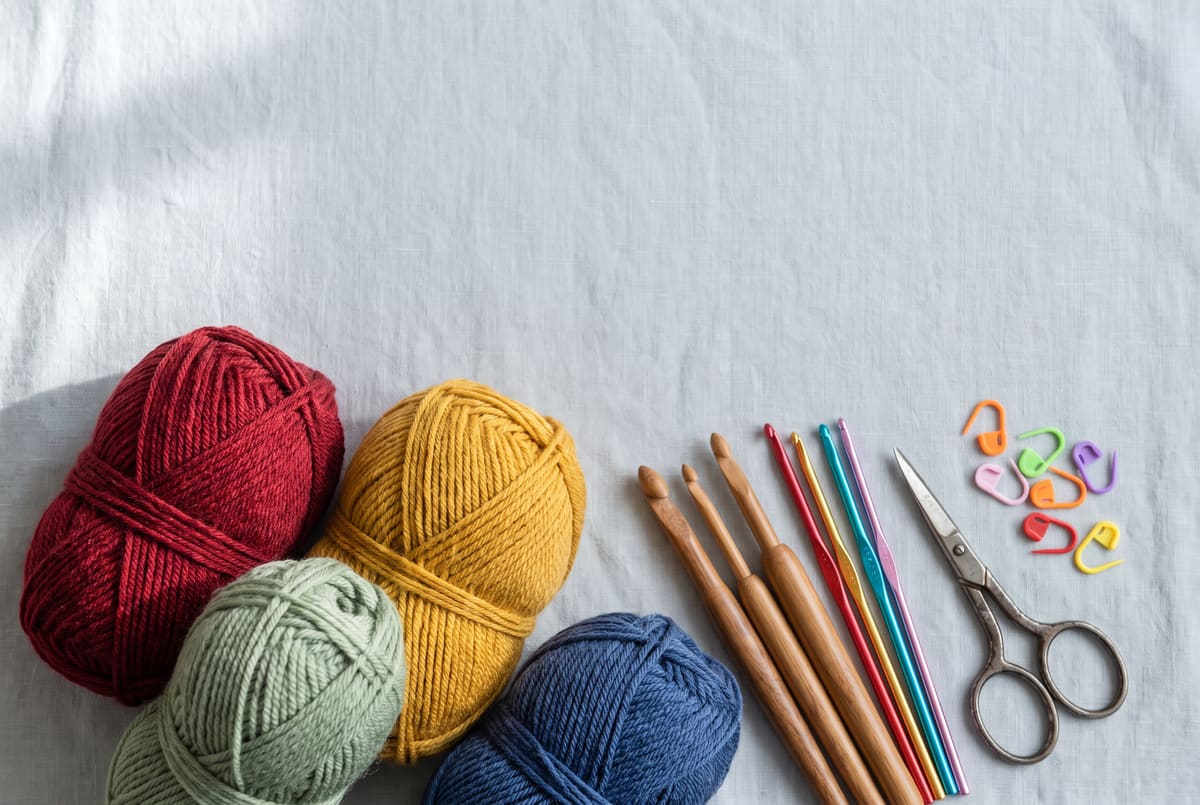
You need one ball of yarn and one hook to begin. Itchin' for Some Stitchin' adds scissors, a yarn needle for weaving in ends, stitch markers and a measuring tape.
- Yarn. Medium weight, number 4 on the label, also called worsted. The Craft Yarn Council expects 11 to 14 single crochet in 4 inches with this weight. Itchin' for Some Stitchin' warns that dark, fuzzy and novelty yarns hide the stitches, so pick a smooth, light color.
- A hook. Sources suggest slightly different sizes, listed in the table below. The crochet hook size chart converts millimeters to US letters and UK numbers.
| Source | Yarn | Hook |
|---|---|---|
| Craft Yarn Council | Medium (4) worsted | 5.5 to 6.5 mm (I-9 to K-10½) |
| Sarah Maker | Medium (4) | G-6 or H-8 (5 mm) |
| Treasurie | Worsted (medium) | H-8 (5 mm) |
| Itchin' for Some Stitchin' | Worsted | 5 to 6 mm |
Letter sizes don't always agree. Sarah Maker lists a G-6 hook as 4.25 mm, and the Craft Yarn Council lists it as 4 mm. The Council's advice is to rely on the millimeter size on the package. The yarn weight chart shows the hook range for every other weight.
The lessons
0 of 12 done
Hold the hook and the yarn
Try the pencil grip and the knife grip, and wrap the working yarn around your fingers so it feeds out evenly.
Practice: Hold the hook both ways for a minute each and keep the one that feels less tense.
Make a slip knot and a chain
Every crochet piece starts with a slip knot on the hook and a row of chain stitches.
Practice: Chain 20, pull it out, and chain 20 again until the loops look the same size.
Single crochet
The shortest basic stitch. It makes a firm, dense fabric and is the first stitch to learn.
Practice: Work 6 rows of single crochet on the practice swatch in the table below.
Half double and double crochet
Two taller stitches built with one extra yarn over at the start. Double crochet grows a piece fastest.
Practice: Add 4 rows of half double, then 4 rows of double crochet to the same swatch.
Turning chains
How many chains to make at the end of each row, and when the turning chain counts as a stitch.
Count your stitches and rows
Read the rows in your fabric so you can spot a lost or added stitch early.
Practice: Count the stitches in every row of your swatch. They should all match.
Crochet abbreviations
The short forms patterns use, such as ch, sc, hdc and dc, and how US and UK names differ.
Read a crochet pattern
What the asterisks, brackets and stitch counts in a pattern tell you, with a real hat crown decoded.
Measure your gauge
Make a swatch, count stitches and rows in 4 inches, and change hook size until it matches the pattern.
Crochet in the round
Start with a magic ring and increase each round so the circle lies flat. Hats and toys use this.
Change colors and join yarn
Switch colors at the end of a row or round, and add a new ball when the old one runs out.
Your first project
Put every lesson together in a beanie or a granny square blanket, with a written pattern made for your size.
Lesson 1: holding the hook and yarn
Sarah Maker describes two ways to hold the hook. She prefers the knife grip for control, but she teaches both, so use the one that feels relaxed.
- Pencil grip. Hold the hook like a pencil, between your thumb and index finger.
- Knife grip. Hold it like a table knife, with your hand over the hook and your palm facing down.
Your other hand holds the work and controls the yarn. My Crochet Space says to loosely wrap the working yarn around your little finger and your index finger. The yarn then slides through your fingers with a little drag, which keeps the loops the same size. DMC holds the hook in the right hand and the yarn in the left. Left-handed crocheters mirror every step.
Lesson 2: slip knot and chain
The slip knot puts the first loop on your hook. Sarah Maker's steps, in short, are these.
- Make a loop about 6 inches from the end of the yarn, crossing the yarn over the tail.
- Put the hook through the loop and catch the working yarn, the yarn that runs to the ball.
- Pull the working yarn through the loop, then pull both ends to snug the knot on the hook.
Now make the chain, which is the foundation row.
- Wrap the yarn over the hook from back to front. This move is called a yarn over.
- Pull the yarn over through the loop on the hook. That is one chain.
- Repeat until you have the number of chains you need.
To count chains, count the V shapes along the front. DMC notes that the loop on your hook "does not count as a chain stitch." Keep the chain loose, since a tight chain makes the first row hard to work.
Lesson 3: single crochet
Single crochet, abbreviated sc, is called double crochet in UK patterns. These steps follow Sarah Maker and DMC.
- Insert the hook into the 2nd chain from the hook.
- Yarn over and pull up a loop. You now have 2 loops on the hook.
- Yarn over again and pull through both loops. One single crochet is done.
- Work one single crochet into each chain to the end of the row.
- To start the next row, chain 1 and turn the work. Work into each stitch of the row below, putting the hook under both loops at the top.
Lesson 4: half double and double crochet
Both stitches start with a yarn over before you insert the hook, which makes them taller than single crochet.
Half double crochet (hdc) is called half treble in UK patterns. It takes three steps.
- Yarn over and insert the hook into the stitch.
- Yarn over and pull up a loop. You have 3 loops on the hook.
- Yarn over and pull through all 3 loops.
Double crochet (dc) is called treble in UK patterns. It takes four steps.
- Yarn over and insert the hook into the stitch.
- Yarn over and pull up a loop. You have 3 loops on the hook.
- Yarn over and pull through 2 loops. You have 2 loops left.
- Yarn over and pull through the last 2 loops.
Taller stitches need a taller turning chain. Sarah Maker gives 1 chain for single crochet, 2 for half double and 3 for double crochet. To finish any piece, cut the yarn with a tail and pull it through the last loop to fasten off.
Chains for a 6 inch practice swatch
This course uses a practice swatch about 6 inches wide. This table runs that width through the foundation chain calculator at real worsted gauges. The single crochet gauge comes from the Red Heart Super Saver label. Half double comes from an Oombawka Design pattern, and double crochet from a Look At What I Made blanket.
| Stitch (US) | Gauge per 4 in | Chains to make | First stitch goes in | Stitches per row |
|---|---|---|---|---|
| Single crochet | 12 stitches | 19 | 2nd chain from hook | 18 |
| Half double crochet | 14 stitches | 23 | 3rd chain from hook | 21 |
| Double crochet | 14 stitches | 23 | 4th chain from hook | 21 |
For double crochet, the 3 turning chains count as the first stitch, so the row total includes them. For the other two stitches they don't count. Your own gauge will differ a little, so treat the chain counts as a starting point.
Your first crochet project
Once the lessons feel familiar, pick one project that uses them all.
- A beanie. The crochet beanie pattern generator writes a full pattern for any head size and yarn. It starts in the round from the crown and works down to a ribbed brim, so it practices rounds, increases and counting.
- A granny square blanket. The granny square blanket pattern generator writes the classic square round by round, then the layout for your blanket size. The guide to joining granny squares covers the seams.
For a bigger goal after that, the guide to crocheting a blanket walks through a one-piece blanket in rows. A blanket uses many balls of yarn, so the guide to joining yarn helps too.
Common beginner mistakes
Itchin' for Some Stitchin' and Treasurie both list these problems for new crocheters.
- Crocheting too tightly. Treasurie says fabric curls when stitches are too tight or the hook is too small for the yarn. Relax your grip, or go up a hook size.
- Losing or adding stitches. Edges that slope in or out mean the stitch count changed. Count each row, or keep a tally with the row counter.
- Mixing up the turning chain. Working into the turning chain when it doesn't count, or skipping it when it does, changes the count by one stitch each row.
- Hard-to-see yarn. Dark, fuzzy and novelty yarns hide the stitches. Save them for later.
- Forgetting the ends. Weave in every tail with a yarn needle as you finish.
Frequently asked questions
How long does it take to learn to crochet?
Treasurie says the basic stitches can take just a few hours, and simple projects such as a dishcloth or scarf a day or two of steady practice. Sew Nikki gives no time at all and says to take your time. Expect your first rows to look uneven, since tension comes with practice.
Can you teach yourself to crochet?
Yes. Sarah Maker, Treasurie and My Crochet Space all teach the basics in free written guides, and My Crochet Space adds a video lesson. Start with the slip knot and chain, then follow the lessons in order.
What size crochet hook should a beginner use?
A hook that matches medium (weight 4) yarn. Treasurie suggests 5 mm (H-8), and the Craft Yarn Council pairs worsted yarn with 5.5 to 6.5 mm. Buy by the millimeter size, because letter sizes vary by brand. The hook size chart converts them.
Is crochet easier to learn than knitting?
Sources disagree. Crochet has only one live loop to manage, while knitting has just two basic stitches to learn. The knit vs crochet guide compares what each source says.
Why is my crochet getting wider or narrower?
Treasurie explains that a piece usually grows when extra stitches creep in at the start or end of rows. Fewer stitches make it narrower. Count every row, and check the turning chain rules for your stitch.
Are US and UK crochet terms different?
Yes, and the same name means a different stitch. A US single crochet is a UK double crochet, and a US double crochet is a UK treble. Check which terms a pattern uses before you start. This course uses US terms.
Sources and further reading
- Sarah Maker, How to Crochet for Beginners: A Complete Guide.
- DMC, Step by Step Crochet Stitch Guide (UK stitch names).
- Treasurie, How to Crochet for Beginners: Complete Step-by-Step Guide.
- My Crochet Space, How to Crochet for Beginners.
- Craft Yarn Council, Hooks and Needles.
Beginner supplies and mistakes also come from Itchin' for Some Stitchin' and Sew Nikki.
Video tutorial
"How to Crochet for Absolute Beginners: Part 1" by simplydaisy, on YouTube. The video loads only when you press play.