How to use the C2C calculator
- Crochet a swatch of 5 by 5 blocks, or larger, in the yarn and hook you plan to use. Block it, then measure across.
- Enter the number of blocks across the swatch and its width. The calculator works out the size of one block.
- Choose a blanket size or type your own width and length.
- For a yarn estimate, weigh the swatch or measure the yarn it used, then add the yardage or weight of one skein.
How corner to corner works
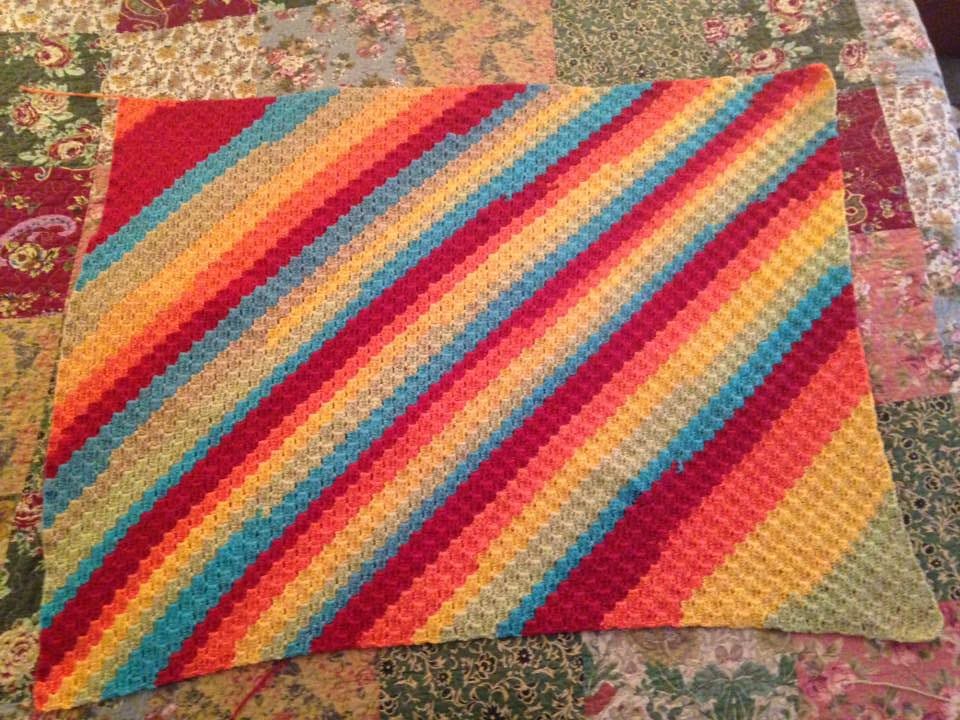
C2C is crocheted on the diagonal. You start with one block in a corner and add a block at each end of every row, so the work grows into a triangle. Once one edge reaches the width you want, that edge starts decreasing. Once the other edge reaches the length, both edges decrease until you finish in the opposite corner with one block.
A square blanket has two phases: increasing on both edges, then decreasing on both. A rectangle has a third phase in the middle, where one edge increases and the other decreases, so the row length stays the same. The diagram in the results colors those phases so you can see where each one starts.
Formulas
- Block size = swatch width ÷ blocks across the swatch.
- Blocks across = blanket width ÷ block size, rounded up (same for blocks down).
- Total rows = blocks across + blocks down − 1.
- Increase rows = the smaller of blocks across and blocks down.
- Yarn = swatch yarn ÷ swatch blocks × total blocks × (1 + extra %).
Worked example: a throw
A 5 by 5 block swatch measures 4 inches across, so each block is 0.8 inches. A 50 by 60 inch throw needs 50 ÷ 0.8 = 62.5, rounded up to 63 blocks across, and 60 ÷ 0.8 = 75 blocks down.
That's 63 + 75 − 1 = 137 rows. Increase on both edges for rows 1 to 63. For rows 64 to 75, keep increasing on one edge and decrease on the other. From row 76 to the end, decrease on both edges. The swatch used 14 yards for 25 blocks, so 4,725 blocks with 10 percent extra comes to about 2,911 yards, or 15 skeins of 200 yards.
C2C blanket sizes in blocks
These counts use 0.8 inch blocks. If your blocks are a different size, use the calculator above.
| Size | Inches | Blocks | Rows |
|---|---|---|---|
| Stroller | 30 × 35 | 38 × 44 | 81 |
| Receiving | 40 × 40 | 50 × 50 | 99 |
| Crib | 45 × 60 | 56 × 75 | 130 |
| Lapghan | 36 × 48 | 45 × 60 | 104 |
| Throw | 50 × 60 | 63 × 75 | 137 |
| Twin | 66 × 90 | 83 × 113 | 195 |
| Full | 80 × 90 | 100 × 113 | 212 |
| Queen | 90 × 100 | 113 × 125 | 237 |
| King | 108 × 100 | 135 × 125 | 259 |
How block size changes a C2C blanket
A small change in block size moves the block count a lot, because it changes both directions at once. This table runs four blankets through the calculator at three block sizes. The yarn keeps the same 14 yards per 25 blocks with 10 percent extra, so it only shows the effect of the count. Bigger blocks made with thicker yarn or a larger hook use more yarn per block, so weigh your own swatch.
| Size | 0.75" blocks | 0.8" blocks | 1" blocks |
|---|---|---|---|
| Crib 45" × 60" | 4,800 blocks, 139 rows, 2,957 yd | 4,200 blocks, 130 rows, 2,588 yd | 2,700 blocks, 104 rows, 1,664 yd |
| Throw 50" × 60" | 5,360 blocks, 146 rows, 3,302 yd | 4,725 blocks, 137 rows, 2,911 yd | 3,000 blocks, 109 rows, 1,848 yd |
| Twin 66" × 90" | 10,560 blocks, 207 rows, 6,505 yd | 9,379 blocks, 195 rows, 5,778 yd | 5,940 blocks, 155 rows, 3,660 yd |
| Queen 90" × 100" | 15,960 blocks, 252 rows, 9,832 yd | 14,125 blocks, 237 rows, 8,701 yd | 9,000 blocks, 189 rows, 5,544 yd |
For a throw, going from 0.75 inch to 1 inch blocks drops the work from 5,360 blocks to 3,000, and from 146 rows to 109. That is the main reason to swatch before you pick a hook. If you follow a pixel graph, the graph fixes the block count, and the block size alone sets the finished size: multiply the graph squares by your block size.
Published block sizes, checked with the calculator
In a GoodKnit Kisses C2C tutorial, a 60" × 80" blanket takes 75 squares across and 100 down. Run through this calculator with 0.8 inch blocks, the same blanket comes out at 75 × 100 blocks over 174 diagonal rows, so the two agree.
Yarn for a C2C border
A border uses yarn on top of the blocks. The calculator's 10 percent safety margin is meant for tension and ends, so if you plan a wide border, raise the extra percentage or work out the border on its own with the blanket yarn calculator.
Tips for C2C blankets
- Mark the row where you change phase with a stitch marker, so you don't miss the switch.
- For a pixel graph, keep a printed copy and cross off each diagonal as you finish it.
- Tight tension at the edges makes a blanket curl. Blocking helps, and so does a simple border.
- C2C blocks can come out a little taller than wide. Measure your swatch both ways before you plan a large project.