How to use the layout calculator
- Choose "I have blocks" or "I want a size".
- Enter the finished block size, ½ inch smaller than the block measures before you sew it in.
- Add a sashing width, or 0 for blocks sewn straight to each other. Tick cornerstones and outer sashing to match your design.
- Add up to two borders. The first one sits against the blocks and the second goes around it.
How the layout math works
Across the quilt there is a row of blocks with a sashing strip in each gap. Four blocks have three gaps, so the center is four block widths plus three sashing widths. Outer sashing adds a strip on each side, and each border adds its width twice. Length works the same way.
In "I want a size" mode the calculator takes the borders off your target, then works out how many blocks plus sashing fit in the space that remains. That rarely comes out whole, so you choose how to round. Round to the nearest count, down so the quilt is never bigger than asked, or up so it is never smaller.
For the cut list, every finished size gets ½ inch added for seam allowances. The pieces then go through the same strip cutting method as our fabric yardage calculator to find the fabric to buy.
Formulas
- Center width = blocks across × block + (blocks across − 1) × sashing, + 2 × sashing with outer sashing.
- Finished width = center width + 2 × (border 1 + border 2), and the same for length.
- Blocks across for a size = (center width + sashing − outer sashing) ÷ (block + sashing), rounded.
- Cornerstones = (across − 1) × (down − 1), or (across + 1) × (down + 1) with outer sashing.
- Side border cut length = top length + ½ inch; top and bottom = top width + 2 × border + ½ inch.
Worked example: twenty 12 inch blocks
The blocks are set 4 across and 5 down with 2 inch sashing and cornerstones. Across, 4 × 12 + 3 × 2 = 54 inches. Down, 5 × 12 + 4 × 2 = 68 inches.
That takes 3 sashing strips in each of the 5 rows and 4 in each of the 4 sashing rows, 31 in all, plus 12 cornerstones. From 42 inch fabric the sashing takes ⅞ yard and the cornerstones ⅛ yard, with 10 percent extra.
The 2 inch inner border adds 4 inches each way, making the top 58 by 72. The 4 inch outer border adds 8 more, for a finished quilt of 66 by 80 inches.
Blocks needed for standard quilt sizes
Blocks set side by side with no sashing or borders, rounded to the nearest count.
| Size | 10" blocks | Top size | 12" blocks | Top size |
|---|---|---|---|---|
| Crib 36" × 52" | 4 × 5 = 20 | 40" × 50" | 3 × 4 = 12 | 36" × 48" |
| Throw 50" × 65" | 5 × 7 = 35 | 50" × 70" | 4 × 5 = 20 | 48" × 60" |
| Twin 68" × 86" | 7 × 9 = 63 | 70" × 90" | 6 × 7 = 42 | 72" × 84" |
| Full 84" × 90" | 8 × 9 = 72 | 80" × 90" | 7 × 8 = 56 | 84" × 96" |
| Queen 90" × 95" | 9 × 10 = 90 | 90" × 100" | 8 × 8 = 64 | 96" × 96" |
| King 108" × 95" | 11 × 10 = 110 | 110" × 100" | 9 × 8 = 72 | 108" × 96" |
How much fabric for quilt sashing
Sashing is the set of strips sewn between quilt blocks, and cornerstones are the small squares where those strips cross. Designed to Quilt sizes cornerstones from the sashing: 3 inch sashing gets 3 inch finished cornerstones. Here is the fabric the calculator gives for the twenty 12 inch blocks above, set 4 by 5 with cornerstones and no borders, from 42" fabric with 10 percent extra.
| Finished sashing | Cut strips | Sashing fabric | Cornerstone fabric | Quilt without borders |
|---|---|---|---|---|
| 1" | 31 at 1½" × 12½" | ⅝ yd | ⅛ yd | 51" × 64" |
| 1½" | 31 at 2" × 12½" | ¾ yd | ⅛ yd | 52½" × 66" |
| 2" | 31 at 2½" × 12½" | ⅞ yd | ⅛ yd | 54" × 68" |
| 3" | 31 at 3½" × 12½" | 1¼ yd | ¼ yd | 57" × 72" |
| 4" | 31 at 4½" × 12½" | 1⅝ yd | ⅜ yd | 60" × 76" |
Going from 2 to 4 inch sashing nearly doubles the sashing fabric and adds 6 inches to the width without one more block. Leaving out the cornerstones changes the cutting more than the fabric. With 2 inch sashing the calculator still asks for ⅞ yard. But the 4 strips between the rows are 54.5 inches long, longer than the usable width of 42" fabric, so you join each one from two pieces.
For help picking a width, and for sewing the rows together, see the quilt sashing guide.
Choosing border widths
Border width is up to you, but Designed to Quilt's border guide offers starting points. You can make the border the same width as the sashing. Or pick a width that relates to the block, such as a 3 inch border around 9 inch Ohio star blocks. For several borders, a golden ratio rule makes each one 1.6 times as wide as the one inside it. Starting at 2 inches and rounding up to the next ¼ inch, that gives 3¼ and then 5¼ inches.
The same guide notes that mitered borders, joined at a 45 degree corner, can need a lot more fabric than butted ones, especially when they are wide. This calculator plans butted borders, so add extra length to each strip if you miter.
Tips for laying out a quilt
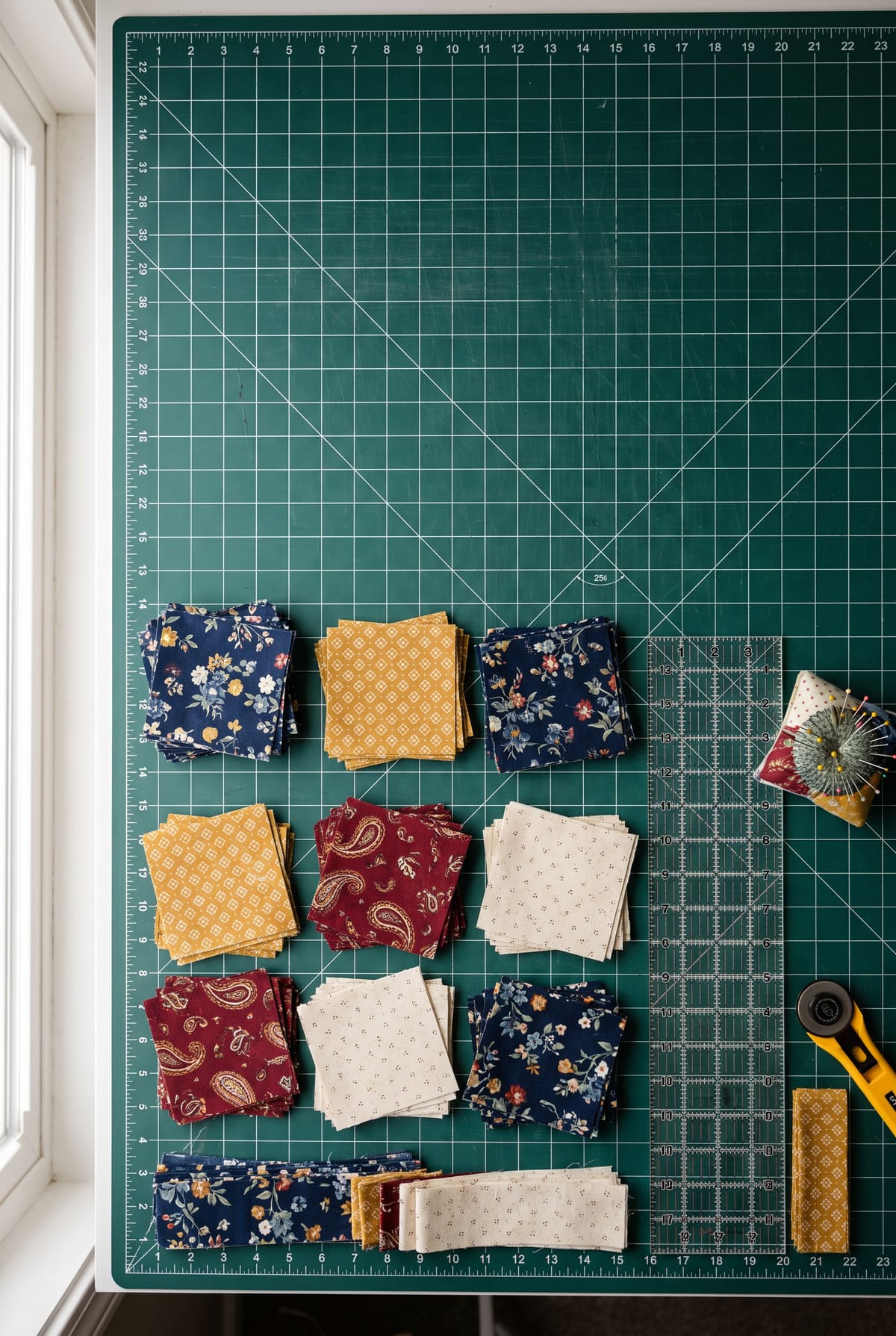
- Lay the blocks out and take a photo before you sew. Color clumps are easier to spot in a photo.
- Measure a few finished blocks. If they vary, trim them all to the smallest size and enter that here.
- Cut border strips after you sew the center and measure it through the middle. The numbers here are a plan, and your top may differ by a little.