Crochet guide
How to crochet a blanket: a beginner's guide from chain to border
Updated by Khokhar Sab
To crochet a blanket, pick a smooth worsted yarn and the hook its label suggests. Chain loosely to the width you want, then work your first row into the chain: single crochet starts in the 2nd chain from the hook, double crochet in the 4th. Turn, chain, and repeat the row until the blanket is long enough. Fasten off, add a border and weave in the ends.
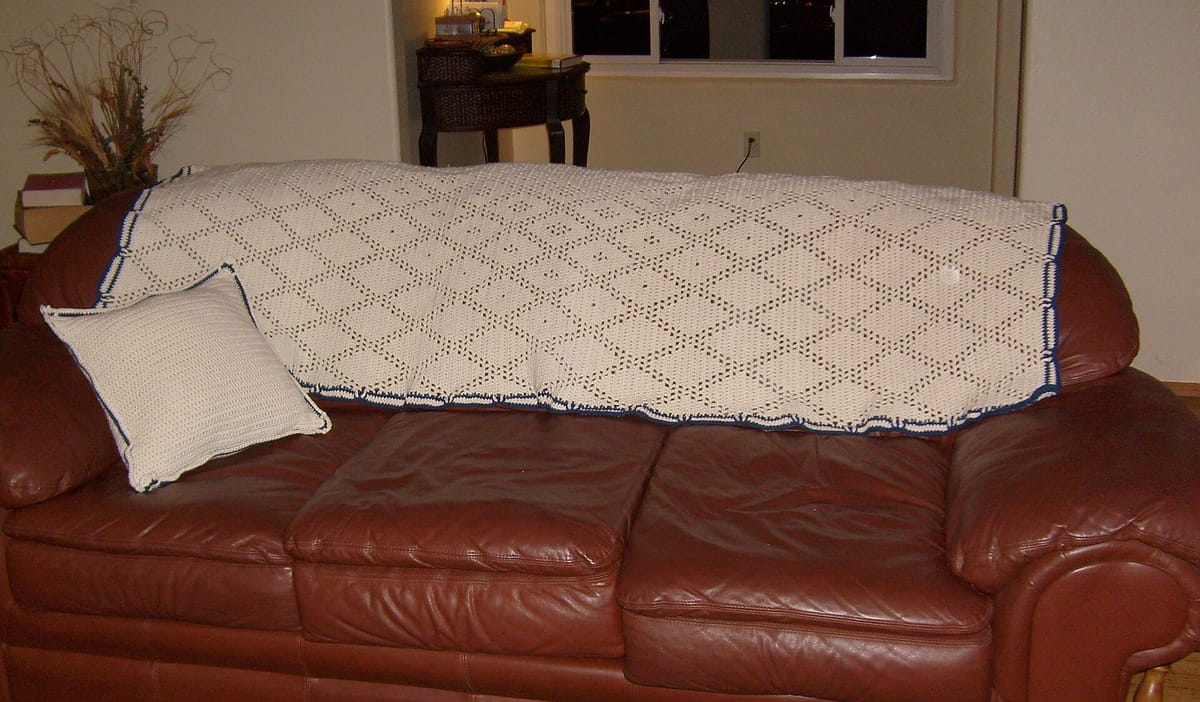
What you need
- Yarn. wikiHow suggests a smooth, light-colored worsted (medium) yarn for a first blanket, because you can see each stitch clearly. Sigoni Macaroni lists weights 2 to 6 as the usual range for blankets. Bulkier yarn works up faster but makes a heavier blanket, per Sarah Maker. The yarn weight chart explains the numbers on the label.
- A hook. The Craft Yarn Council pairs worsted yarn with a 5.5 to 6.5 mm hook (US I-9 to K-10½). Sigoni Macaroni goes up two sizes from the label for a softer drape, so make a swatch and see which feel you like. The crochet hook size chart converts millimeters to US letters.
- A yarn needle with a blunt tip for weaving in ends, scissors and a few stitch markers.
If you buy several skeins, check that they share one dye lot number. wikiHow notes that skeins from different lots can differ slightly in color.
Pick a size
Sarah Maker suggests a one-piece blanket for a first project, since a blanket of many small squares means a lot of seaming. A baby blanket is the quickest to finish. The blanket yarn calculator uses a 40 × 40 inch receiving blanket, a 50 × 60 inch throw and a 90 × 100 inch queen. Published charts don't all agree, so the blanket size chart lists every common size, lovey to king, and shows how they differ.
How to crochet a blanket, step by step
- Make a swatch. Work about 5 inches square in the stitch you plan to use, then count the stitches and rows in 4 inches. The gauge guide shows how.
- Make the foundation chain as wide as the blanket, plus the turning chain for your stitch.
- Work the first row into the chain and count the stitches.
- Turn, chain and work the next row. Repeat until the blanket is long enough, counting stitches now and then.
- Join new yarn at the end of a row when a skein runs out.
- Fasten off. Cut the yarn, leaving a tail, and pull it through the last loop.
- Add a border, then weave in every end.
The sections below cover each step in more detail.
Make the foundation chain
The foundation chain sets the width of the blanket. To find how many chains to make, multiply the width by your stitches per inch, then add the turning chain, less one if it counts as a stitch. The foundation chain calculator does this for any width and gauge.
Keep the chain loose. A tight chain pulls the bottom edge narrower than the rest of the blanket. Attic24 describes a blanket "bowing like a rainbow" from a tight chain. Its fix is to make the chain with a hook two sizes larger, then switch back down for the rows.
Or start with foundation single crochet
Foundation single crochet builds the chain and the first row of single crochet at the same time. Marly Bird says it avoids the starting chain that comes out tighter than the rest, gives a stretchier edge and leaves a neat V edge to work into later. It takes a little practice, but there is no chain to count back into.
Work the first row
The first stitch goes into a chain a few chains from the hook. The skipped chains stand in for the turning chain, which is the height of the stitch. Count from the hook and leave out the loop on the hook itself.
| Stitch | Turning chain | First stitch goes into |
|---|---|---|
| Single crochet | 1 | 2nd chain from the hook |
| Half double crochet | 2 | 3rd chain from the hook |
| Double crochet | 3 | 4th chain from the hook |
Work one stitch into every chain to the end, then count. If the count is off, fix it now. One missing stitch here becomes a crooked edge later.
Work rows and keep the edges straight
At the end of each row, turn the work, make the turning chain and work back across. Sarah Maker suggests counting your stitches at the end of a row, especially as a beginner. Count every row at first, then every few rows once the edges look even.
Edges usually drift because of the first or last stitch. Whether the turning chain counts as a stitch decides where the first stitch of each row goes, and mixing the two up adds or loses one stitch per row. The turning chains guide explains when the chain counts. A stitch marker in the top of each turning chain shows you where the last stitch of the next row belongs.
Easy stitches for blankets
- Single crochet makes a dense, firm fabric. It is the shortest stitch, so a blanket takes the most rows.
- Half double crochet sits between the two in height. Sarah Maker's free throw pattern uses half double ribbing, worked in the back loop.
- Double crochet is taller, softer and quicker. Sigoni Macaroni names it as the stitch that works up fastest.
- Moss stitch is the third beginner choice Sarah Maker lists, with half double and double crochet.
These basic stitches need no stitch multiple, so any chain count works. Patterned stitches do. Sigoni Macaroni gives the granny stripe as an example, worked on a multiple of 3 plus 2. Textured stitches such as bobbles, waffle stitch and basketweave use much more yarn, the same source warns.
Chains, rows and yarn for three blanket sizes
This table runs each size through the foundation chain and blanket yarn calculators at real worsted gauges on a 5.5 mm hook. The single crochet gauge, 12 stitches and 15 rows in 4 inches, comes from the Red Heart Super Saver label. Half double uses 14 and 12, from an Oombawka Design half double pattern in Red Heart Soft. Double crochet uses 14 and 8, from the Lazy Waves blanket from Look At What I Made. Your own gauge will differ, so treat these as a check on your plan.
| Size and stitch | Chains to make | Rows | Stitches in all |
|---|---|---|---|
| Baby (receiving), sc | 121 | 150 | 18,000 |
| Baby (receiving), hdc | 142 | 120 | 16,800 |
| Baby (receiving), dc | 142 | 80 | 11,200 |
| Throw, sc | 151 | 225 | 33,750 |
| Throw, hdc | 177 | 180 | 31,500 |
| Throw, dc | 177 | 120 | 21,000 |
| Queen, sc | 271 | 375 | 101,250 |
| Queen, hdc | 317 | 300 | 94,500 |
| Queen, dc | 317 | 200 | 63,000 |
Stitch height changes the work more than stitch width. The baby blanket in double crochet needs 80 rows against 150 in single crochet. For the throw, double crochet means 38% fewer stitches than single crochet, 21,000 against 33,750. That is the math behind calling double crochet the fast choice.
How much yarn each size takes
The blanket yarn calculator's quick estimate for worsted yarn gives these ranges, with 10 percent extra.
| Size | Inches | Approximate yards |
|---|---|---|
| Baby (receiving) | 40 × 40 | 1,320 to 1,760 |
| Throw | 50 × 60 | 2,475 to 3,300 |
| Queen | 90 × 100 | 7,425 to 9,900 |
As a check, Red Heart's Crochet Wrapped In Gifts Blanket is a 50 × 60 inch throw in single crochet at the same 12 stitch, 15 row gauge. Its materials list adds up to 2,582 yards, inside the throw range above. Your stitch and tension can move the real figure a long way, so the blanket yarn calculator works from your own swatch. The swatch estimating guide walks through that method by hand.
Join new yarn
Dummies advises against simply knotting the new ball to the old tail. Change yarn at the end of a row where you can, so the join hides in the edge.
- Work the last stitch of the row until 2 loops remain on the hook.
- Wrap the new yarn around the hook and pull it through both loops.
- Tug the old yarn to snug up that stitch, then carry on with the new yarn.
- Leave both tails long enough to weave in later.
The same move changes colors for stripes. The pattern reading guide helps if a stripe pattern lists its rows in brackets.
Finish the blanket
When the blanket reaches its length, fasten off. A border tidies uneven row ends and frames the blanket. Sarah Maker suggests a simple half double border with 3 stitches in each corner. The crochet border guide covers border styles, corners and how many stitches to work along the sides.
Weave in every end with a blunt yarn needle. Heart Hook Home suggests three passes: one through the stitches, one back the other way and a third in the first direction. Pass the needle through the yarn's fibers, weave on the wrong side if there is one, and trim close. Crocheting over the tails for a few stitches as you go saves work at the end. Sarah Maker finishes with blocking to even out the stitches.
Common questions
Can a beginner crochet a blanket?
Yes. Sarah Maker calls a blanket a big rectangle, and Sigoni Macaroni says blankets suit a first project. A baby or lap size gets you to the finish sooner.
What is the easiest stitch for a crochet blanket?
Half double and double crochet, worked in plain rows. Both repeat one stitch across every row, and double crochet needs the fewest rows of the three.
How many chains do I need for a blanket?
Width in inches times your stitches per inch, plus the turning chain. For single crochet the chain doesn't count as a stitch, so at 12 single crochet per 4 inches, a 50 inch throw needs 151 chains. Your swatch gives the real number.
Why is my blanket getting wider or narrower?
A stitch is being added or skipped at the edge. Count the last row, then check where the first and last stitches go against the turning chain.
Two finishing steps have their own guides: blocking evens out the stitches and squares the edges, and changing colors covers stripes and where to leave the tails.
Sources and further reading
Sarah Maker's How to Crochet a Blanket covers patterns, stitches, counting and finishing. The Craft Yarn Council's Standard Yarn Weight System gives the worsted hook range. Attic24's Granny Stripe Blanket explains the larger hook for the chain. Marly Bird teaches foundation single crochet, and Heart Hook Home shows how to weave in ends that stay put. Yarn and size advice also comes from wikiHow and Sigoni Macaroni, and the join from Dummies. The gauges and yardage come from Ravelry, Red Heart, Oombawka Design and Look At What I Made.
Video tutorial
"How to Crochet a Blanket Step-by-Step (for Complete Beginners!)" by B.Hooked Crochet, on YouTube. The video loads only when you press play.