Scroll sideways to see the whole graph. Heavier lines mark every 10 blocks.
Yarn key
Written rows (C2C, from the bottom right corner)
Odd rows run from the top-right end of the diagonal to the bottom-left end; even rows run the other way. Left-handed? Start at the bottom left and read each row mirrored.
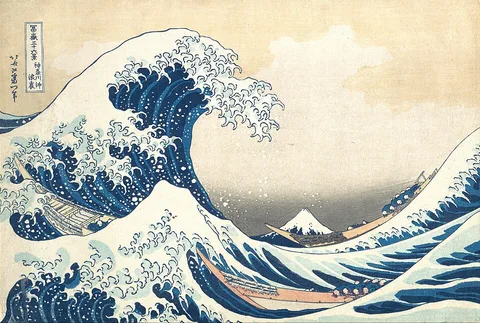
Choose a picture, set the blocks across and the number of colors, and the maker draws a corner-to-corner (C2C) crochet graph. It lists the yarn for each color from your own swatch and writes out every row as color counts. The sample, Hokusai's The Great Wave, becomes 60 × 40 blocks in 8 colors: 99 C2C rows and about 1,483 yards of worsted yarn.
How to make a crochet graph from a picture
Choose a picture. Bold shapes and a plain background work best.
Set the blocks across. Rows of blocks follow the shape of your picture.
Set the most colors you want. The maker picks colors that are really in your picture.
Enter your swatch: blocks across, its width and the yarn it used. The size and yarn update straight away.
Check the graph and the finished look, then change the size or colors until the picture reads well.
Download the PDF. It has the yarn key, the graph on numbered pages and every row written out.
The print
60 blocks across, 8 colors
Each square is one C2C block. At this size the wave and Mount Fuji stay clear, while the boats shrink to a few blocks.
How big will my C2C blanket be?
Size depends on blocks and your block size. Here is the sample at four widths, with a worsted swatch of 5 blocks in 4 inches that used 14 yards, the same defaults as our C2C calculator.
The Great Wave as a C2C graph at 40, 60, 80 and 100 blocks across: rows, finished size, yarn and color changes
Blocks across
Blocks down
C2C rows
Finished size
Yarn
Color changes
40
27
66
32" × 21.6"
670 yd
479
60
40
99
48" × 32"
1,483 yd
1,054
80
54
133
64" × 43.2"
2,665 yd
1,784
100
67
166
80" × 53.6"
4,132 yd
2,659
Yarn grows with the area, so doubling the width roughly quadruples the yarn. Color changes grow almost as fast, and they take time too: each one means switching to a new strand and later weaving in ends.
How many colors should a crochet graph have?
We ran the sample at 60 blocks across with four color limits. A lone block is a single block whose color matches none of its neighbors; tidying gives it the color around it.
The Great Wave at 60 blocks across with 4, 6, 8 and 12 color limits: colors used, color changes after and before tidying, and lone blocks tidied
Color limit
Colors used
Color changes
Before tidying
Lone blocks tidied
4
4
756
785
54
6
6
922
962
70
8
8
1,054
1,075
67
12
12
1,145
1,162
56
Going from 4 to 12 colors took the sample from 756 to 1,145 color changes. Tidying lone blocks cut the count at every limit; at 8 colors it went from 1,075 to 1,054. Total yarn barely moves with the color limit, since the number of blocks stays the same. What changes is how many skeins you start: every color needs at least one.
Reading the graph and the written rows
Each square is one block, and each color has a letter in the yarn key. C2C is worked on the diagonal, starting at the bottom-right corner, as the CrazyPatterns C2C guide describes. Odd rows run from the top-right end of the diagonal to the bottom-left end, and even rows run the other way.
The written rows turn that into counts. Row 40 of the sample, its longest at 40 blocks, reads: 1E, 1F, 1H, 1E, 1C, 1D, 1G, 1H, 2E, 1A, 4F, 1G, 1C, 11A, 12B. Each part is a count and a color letter: 12B means 12 blocks of color B in a row. Cross each row off the PDF as you finish it.
For the color change itself, Nicole Riley's C2C color change tutorial switches yarn in the last double crochet of the block before the new color. She carries the old yarn along only when the blocks around it are the same color. Our guide on changing colors in crochet covers ends and joins.
Getting the yarn amounts right
Yarn depends on your hook, tension and yarn, so the maker starts from your own swatch. Crochet a square of 5 × 5 blocks, block it, measure it, then unravel it and measure the yarn. Divide by 25 and you have yards per block. The Craft Yarn Council weight system helps you keep every color in the same yarn weight, which keeps the blocks the same size.
The extra allowance (10 percent by default) covers ends and small mistakes. Buy one more skein of your main color if it comes in dye lots.
Which pictures make good crochet graphs?
Blocks are big, so a graph shows shapes better than fine detail. Cartoons, logos, letters and bold photos work well; busy backgrounds turn into scattered blocks. Your own pictures are safe to use. Old artwork such as Hokusai's print is in the public domain, while characters and other people's photos usually need permission, especially if you plan to sell the pattern.
Video tutorial
"Corner to Corner (C2C) Basics: How to Read Graphs & Written Instructions" by Nana's Crafty Home | Tonya Bush, on YouTube. The video loads only when you press play.
Embed this calculator on your site
Free to use on a blog, guild site or class page. Paste the code into an HTML block. Please keep the credit line under the calculator.
Assumptions and sources
What the calculator assumes
Each block of the graph takes the average color of the picture pixels inside it. Blocks that are mostly see-through are left empty.
The picture's colors are grouped into as many clusters as your color limit allows (k-means in CIELAB, a color space laid out the way people see). Each cluster is shown by the real picture color closest to its center.
Tidying gives a lone block the color around it when at least three of its four neighbors share that color.
Yarn per block is the yarn your swatch used divided by its blocks, as in the C2C calculator. Each color gets its blocks times that, plus your extra allowance, rounded up to a whole yard.
Finished size is blocks times the block size from your swatch. C2C blocks are square, so width and height use the same size.
Written rows start with the bottom-right block. Odd rows run from the top-right end of the diagonal to the bottom-left end, even rows the other way. Left-handed crocheters start at the bottom left and mirror this.
A color change is counted every time the next block in a C2C row has a different color from the block before it.
Yes. There is no sign-up and no limit, and the PDF graph with written rows is free to download.
Is my picture uploaded?
No. The graph is made inside your browser, so the picture never leaves your device.
How many blocks across should a C2C graph be?
Divide the width you want by your block size. With a 5 block swatch that measures 4 inches, each block is 0.8 inches, so a 48 inch blanket is 60 blocks across. Our sample at 60 blocks comes out 48" × 32".
How many colors should a crochet graph have?
Each color adds yarn ends and changes. Our sample at 60 blocks had 756 color changes with 4 colors and 1,145 with 12. Start low, look at the finished view, and add colors only where the picture needs them.
Can I use the graph for single crochet or tapestry crochet?
Yes, one square can be one single crochet instead of one C2C block. The yarn and size numbers are worked out for C2C blocks, so swatch in your stitch and enter its size and yarn, or use the graph only.
Which corner do I start a C2C graph from?
Right-handed crocheters usually start at the bottom right, and the written rows here follow that. Left-handed crocheters can start at the bottom left and read each row mirrored.