Knitting guide
How to substitute yarn in a knitting or crochet pattern
Updated by Khokhar Sab
Choose a yarn in the same weight group, then compare yards per 100 grams to check it is a similar thickness. Swatch to match the pattern's gauge. Finally, multiply the pattern's ball count by the yards per ball to get the total yards, divide by the yards in one ball of your yarn and round up.
How to substitute yarn in a pattern, in five steps
Patterns name a specific yarn, but you don't have to use it. It may be sold out, too expensive or the wrong fiber for you. A good swap gives the same fabric at the same gauge, so the finished piece comes out the size the pattern says.
- Match the weight number.
- Compare yards per 100 grams.
- Swatch and match the gauge.
- Think about fiber and texture.
- Work out how much to buy, by yards.
Step 1: match the weight number
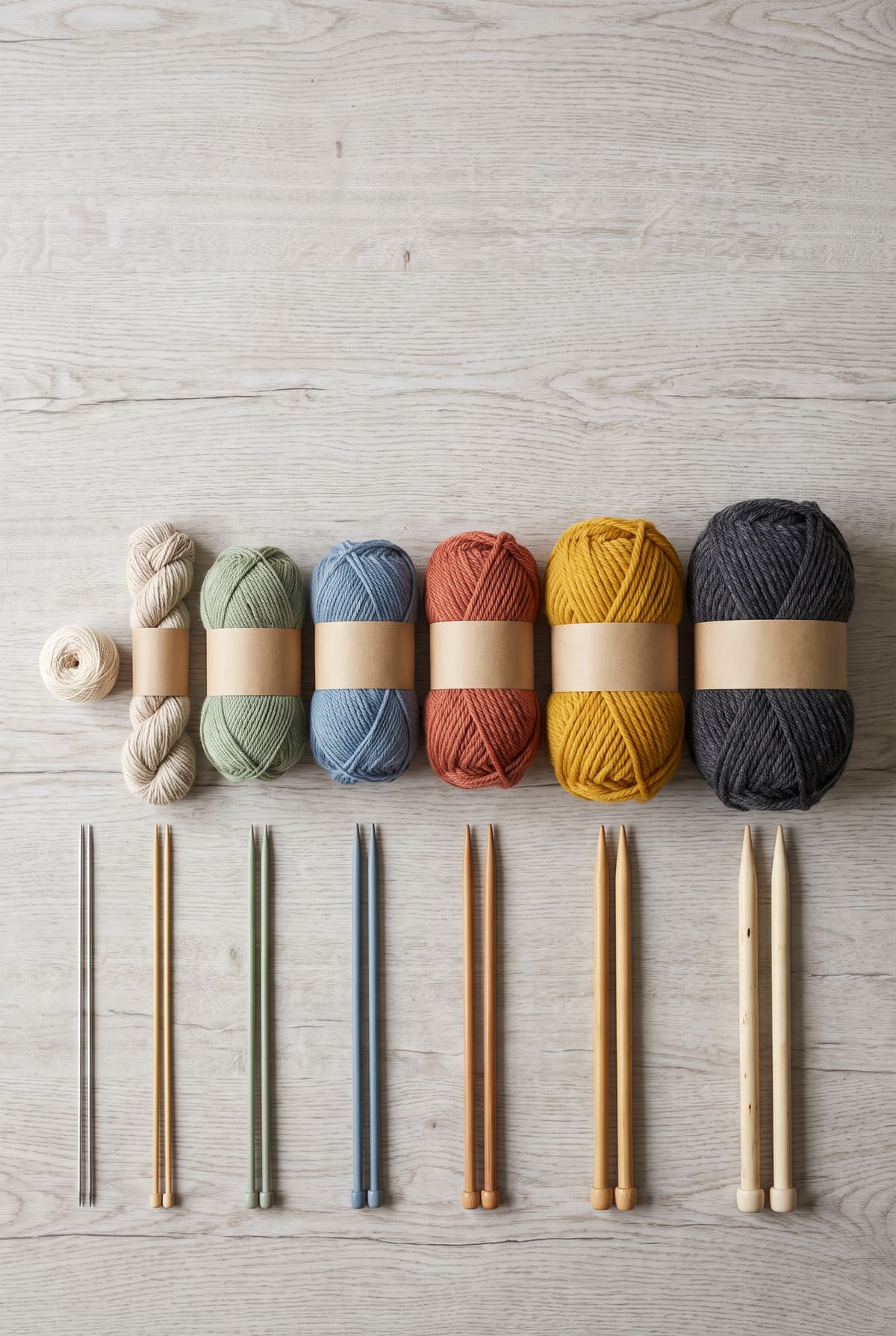
The Craft Yarn Council's Standard Yarn Weight System sorts yarn into groups numbered 0 to 7, from lace to jumbo. Look for the number on the label. If the pattern calls for a medium (4) yarn, start with other 4s.
| Weight | Also called | Knit stitches per 4 in | Crochet stitches per 4 in |
|---|---|---|---|
| 0 Lace | Fingering, 10-count crochet thread | 33 to 40 | 32 to 42 (double crochet) |
| 1 Super fine | Sock, fingering, baby | 27 to 32 | 21 to 32 |
| 2 Fine | Sport, baby | 23 to 26 | 16 to 20 |
| 3 Light | DK, light worsted | 21 to 24 | 12 to 17 |
| 4 Medium | Worsted, afghan, aran | 16 to 20 | 11 to 14 |
| 5 Bulky | Chunky, craft, rug | 12 to 15 | 8 to 11 |
| 6 Super bulky | Super chunky, roving | 7 to 11 | 7 to 9 |
| 7 Jumbo | Jumbo, roving | 6 or fewer | 6 or fewer |
The council calls these figures guidelines only. Each group covers a range: a 4 can knit anywhere from 16 to 20 stitches per 4 inches. Two yarns with the same number can still behave differently, which is why the next step matters. The yarn weight chart adds needle and hook sizes, and the guide to yarn weights explains the names.
Step 2: compare yards per 100 grams
Yards per 100 grams tells you how thick a yarn is, even inside one weight group. A thicker yarn has fewer yards in the same weight. To compare two labels, divide the yards by the grams and multiply by 100.
- Pattern yarn: 220 yards in 100 grams is 220 yards per 100 g.
- Your yarn: 105 yards in 50 grams is 105 × 100 ÷ 50 = 210 yards per 100 g.
The difference is (210 − 220) ÷ 220 = -4.5 percent. That is a close match.
In her tips for yarn substitution, Elizabeth Smith suggests staying within about 20 to 25 yards of the suggested yarn when you compare balls of the same weight. The yarn substitution calculator uses a percentage instead and warns when the gap is over 10 percent. For a yarn with 220 yards per 100 g, 10 percent is 22 yards.
If you don't have the pattern yarn's label, look it up. The Loopy Lamb's substitution guide suggests Ravelry's yarn database or the maker's website for the yards per ball.
Now try a yarn with 190 yards in 100 grams. It comes out -13.6 percent, so the calculator flags it. That yarn is heavier per yard and probably thicker, so swatch it with care.
Five bulky yarns with the same number
Designer Talena Winters photographed five 100 gram skeins of bulky (5) yarn in her post on how to substitute yarn. Their labels range from 108 to 165 yards, a 53 percent spread inside one weight group. The table treats her 137 yard superwash wool as the pattern yarn, at 5 balls, and runs the other four through the yarn substitution calculator.
| Fiber | Yards per 100 g | Difference | Over 10%? | Balls for 685 yd |
|---|---|---|---|---|
| Baby alpaca | 108 | -21.2% | Yes | 7 |
| Wool | 165 | +20.4% | Yes | 5 |
| Cotton | 120 | -12.4% | Yes | 6 |
| Cotton | 132 | -3.6% | No | 6 |
Only the 132 yard cotton stays inside the 10 percent warning line, even though all five skeins carry the same number on the label. The alpaca would need 7 balls where the pattern asks for 5.
Fiber explains part of the spread. Winters notes that cotton is a denser fiber than alpaca. So a bulky cotton weighs more per yard and has fewer yards in 100 grams than a bulky alpaca of the same thickness. Yards per 100 grams works best between yarns of similar fiber. Across fibers, compare the label gauge too, and then swatch.
Step 3: swatch and match the gauge
A matching weight and yardage only predict the gauge. A swatch proves it. Knit or crochet a swatch at least 6 inches square in the new yarn, using the pattern's stitch. Wash it the way you'll wash the finished piece, then count.
If you get more stitches per 4 inches than the pattern, go up a needle or hook size. If you get fewer, go down. The guide on how to measure gauge covers the details.
Once the gauge matches, look at the fabric too. A substitute can hit gauge and still feel stiff or loose. If it feels wrong, try another needle size or another yarn.
Step 4: think about fiber and texture
Elizabeth Smith points out that fiber changes how a fabric drapes. Cotton, wool, alpaca and linen hang differently even at the same gauge. If the pattern yarn is a wool blend, a similar blend gets you closest to the photos.
Texture matters as well. Her tips note that very textured or variegated yarns can hide stitch detail. For lace, cables or slipped stitches, a smooth, solid yarn shows the pattern best.
Yarn construction
How a yarn is built matters as much as its fiber. Winters compares a few types. A single-ply roving gives a soft, almost felted look but breaks more easily. A tightly twisted plied yarn is stronger with crisper stitches, and a chainette is strong but may not lie flat. Novelty yarns such as eyelash, ribbon and fur suit specific designs, and she advises against swapping them for plied yarn unless you are happy to experiment.
If you can't tell a yarn's construction from the photo, check its Ravelry page or ask the shop. Pick a construction close to the pattern yarn's.
Step 5: work out how much yarn to buy
Buy by length, not by weight or ball count. Balls of different yarns hold different yardage, so "5 balls" of one yarn may not equal 5 balls of another.
- Find the total yards: 5 balls × 220 yards = 1100 yards.
- Divide by the yards in one ball of your yarn: 1100 ÷ 105 = 10.48.
- Round up to 11 balls. You can't buy part of a ball.
That gives 1155 yards and 550 grams, with 55 yards to spare. The pattern called for 500 grams, so buying by weight would have left you short. The heavier yarn from step 2 needs 6 balls of 190 yards, with 40 yards to spare.
Buy every ball from one dye lot. If you change the length or size of the piece, add yarn for that as well. To convert one yarn's grams into yards, use the yarn yardage converter.
Using a different weight, or two strands held together
Sometimes the yarn you want to use is a different weight. Simply Yarn's guide on how to substitute yarns says this can work within limits. A thicker yarn on a smaller hook or needle can reach the pattern's gauge, but the stitches pack together into a stiffer, denser fabric. A thinner yarn on a bigger tool gives a looser, more open fabric. The guide says you can't push the gap far: super chunky in place of 4 ply won't work.
The same guide suggests holding two strands together to make a thicker yarn, for example two strands of DK for a pattern that calls for chunky. It calls this "not an exact science", so swatch before you commit. Add up the yards for both strands when you buy: a pattern that needs 1100 yards needs 1100 yards of each strand, or 2200 in all.
When a substitute is close enough
A substitute is close enough when it is in the same weight group and sits within about 10 percent on yards per 100 grams. It also has to give the pattern's gauge in a fabric you like. Fitted pieces such as sweaters and socks need all three. For a scarf or blanket, a small gauge difference only changes the size a little and how much yarn you use.
Sources and further reading
- Craft Yarn Council: Standard Yarn Weight System.
- Simply Yarn: how to substitute yarns.
- Elizabeth Smith Knits: 5 tips for yarn substitution.
- The Loopy Lamb: substituting yarn in crochet patterns.
- Talena Winters: how to substitute yarn.
Video tutorial
"How to Substitute Different Yarn Weights in a Knitting Pattern" by WatchBarbaraKnit, on YouTube. The video loads only when you press play.