Needle makers size knitting needles by their diameter in millimeters. A US 8 needle is 5 mm, which is a UK 6 in the old system; a US 6 is 4 mm.
Free to print for personal use. Last reviewed .
Quick needle converter
Knitting needle sizes in millimeters, US and old UK
Metric
US
Old UK
2 mm
0
14
2.25 mm
1
13
2.5 mm
none
none
2.75 mm
2
12
3 mm
none
11
3.25 mm
3
10
3.5 mm
4
none
3.75 mm
5
9
4 mm
6
8
4.5 mm
7
7
5 mm
8
6
5.5 mm
9
5
6 mm
10
4
6.5 mm
10½
3
8 mm
11
0
9 mm
13
00
10 mm
15
000
12.75 mm
17
none
15 mm
19
none
19 mm
35
none
25 mm
50
none
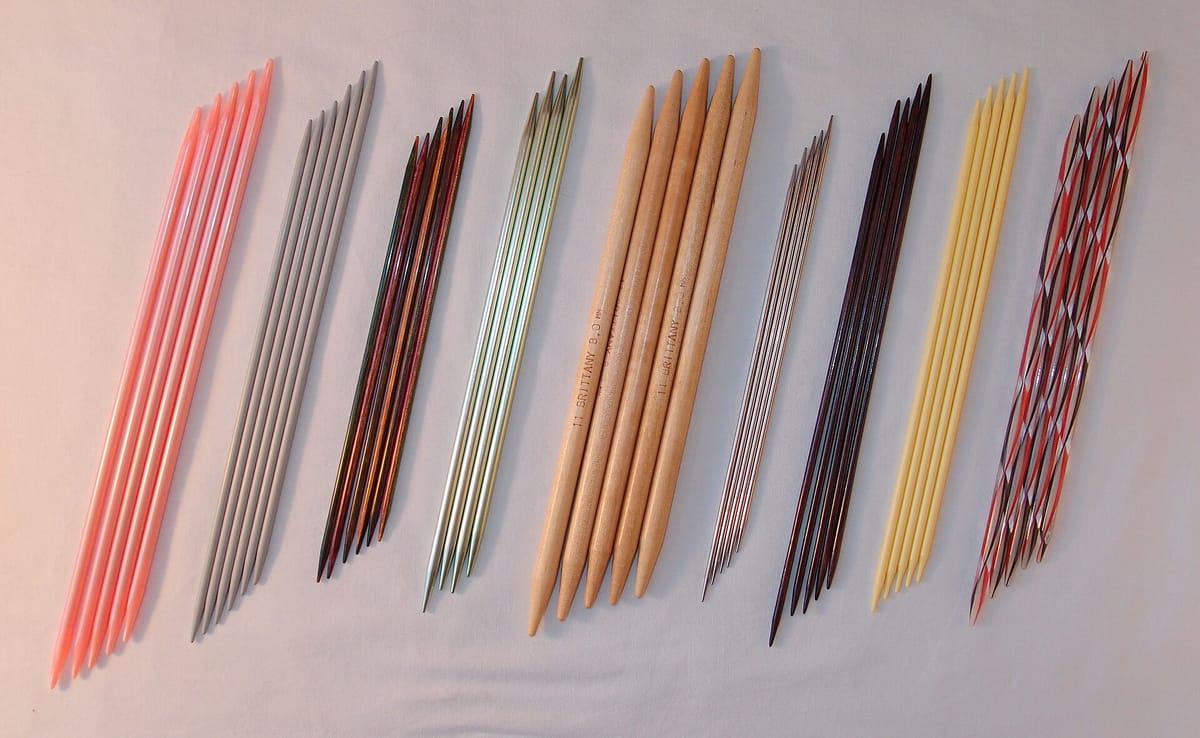
Double-pointed knitting needles in various sizes and materials. Photo: Pschemp, CC BY-SA 3.0, via Wikimedia Commons.
How to use the knitting needle size chart
Look up the size from your pattern in any column and read across to the system your needles use. Circular needles, straights and double-pointed needles all use the same sizing. If a needle has lost its markings, a needle gauge (a card with holes) tells you the millimeter size. The Craft Yarn Council hooks and needles standard lists the same metric and US sizes.
Matching needles to yarn
The yarn label suggests a needle size and the gauge you should get with it. Treat that as a starting point: knit a swatch, measure it, and change needle size until your stitches per 4 inches match the pattern. Our yarn weight chart shows the usual needle range for each yarn weight.
Needle sizes for each yarn weight
The Craft Yarn Council pairs each yarn weight with a needle range. Use it to find a starting size, then swatch.
Recommended knitting needle sizes for yarn weights 0 to 7
Yarn weight
Needle (mm)
Needle (US)
Knit gauge (sts per 4 in)
0 Lace
1.5 to 2.25
000 to 1
33 to 40
1 Super fine
2.25 to 3.25
1 to 3
27 to 32
2 Fine
3.25 to 3.75
3 to 5
23 to 26
3 Light
3.75 to 4.5
5 to 7
21 to 24
4 Medium
4.5 to 5.5
7 to 9
16 to 20
5 Bulky
5.5 to 8
9 to 11
12 to 15
6 Super bulky
8 to 12.75
11 to 17
7 to 11
7 Jumbo
12.75 and larger
17 and larger
6 or fewer
Japanese knitting needle sizes
Japanese patterns use their own numbers. Sarah Maker and Sheep and Stitch list the same sizes, from 0 at 2.1 mm to 15 at 6.6 mm, in steps of 0.3 mm. Only 3.0, 4.5 and 6.0 mm match a size in our chart exactly; the rest fall between two of ours. The last column shows the closest size in the chart above.
Japanese knitting needle sizes in millimeters with the nearest metric and US size
Japanese
Metric
Nearest in our chart
0
2.1 mm
2 mm (US 0)
1
2.4 mm
2.5 mm (US )
2
2.7 mm
2.75 mm (US 2)
3
3.0 mm
3 mm (US )
4
3.3 mm
3.25 mm (US 3)
5
3.6 mm
3.5 mm (US 4)
6
3.9 mm
4 mm (US 6)
7
4.2 mm
4 mm (US 6)
8
4.5 mm
4.5 mm (US 7)
9
4.8 mm
5 mm (US 8)
10
5.1 mm
5 mm (US 8)
11
5.4 mm
5.5 mm (US 9)
12
5.7 mm
5.5 mm (US 9)
13
6.0 mm
6 mm (US 10)
14
6.3 mm
6.5 mm (US 10½)
15
6.6 mm
6.5 mm (US 10½)
Needle lengths: straight, circular and double-pointed
Size is the diameter. Length is a separate choice. According to Sarah Maker, straight needles typically come in 10, 14 and 16 inch lengths. Circular needles are measured from tip to tip, and the common lengths are 16 inches (40 cm), 24 inches (60 cm), 32 inches (80 cm) and 47 inches (120 cm). Choose one shorter than the circumference of your project. Double-pointed needles run from 4 inches (10 cm) to 8 inches (20 cm).
By that rule, a 16 inch circular needs a tube more than 16 inches around. For smaller tubes the Needle & Arts basic sock formula lists three options: 4 or 5 double-pointed needles, two circular needles, or the magic loop method on one long circular. Our sock calculator and sweater calculator give the stitch counts once you have picked your needles.
Where conversion charts disagree
US numbers are not tied to one exact diameter. The Craft Yarn Council says to rely on the millimeter size, because letter and number sizing vary from company to company. Its own list shows a few differences from the chart above:
It lists no US number for 2.5 mm, 3 mm or 7 mm. Some older charts call 2.5 mm US 1½ and 3 mm US 2½, but those are not standard sizes, so our chart leaves them blank.
It gives US 3 as 3.125 or 3.25 mm, US 6 as 4 or 4.25 mm and US 9 as 5.25 or 5.5 mm.
It gives US 17 as 12.5 or 12.75 mm. Our chart uses 12.75 mm.
It also lists 1.5 mm (US 000), 1.75 mm (US 00) and 35 mm (US 70), outside the range of this chart.
When a pattern gives both, follow the millimeters. The 4.5 to 5.5 mm range for worsted, for example, means the same thing on any brand's packet.
A US 8 needle is 5 mm. It sits in the middle of the 4.5 to 5.5 mm range the yarn weight standard lists for worsted yarn.
What needle size for worsted yarn?
Worsted (medium, weight 4) yarn usually calls for 4.5 to 5.5 mm needles, which is US 7 to 9. Check the label and swatch, since tension varies from knitter to knitter.
Why do old UK needle sizes go down as needles get bigger?
Old UK sizes came from wire gauge numbers, where a higher number meant thinner wire. So a UK 14 is a thin 2 mm needle and a UK 000 is 10 mm. Modern UK patterns use millimeters.
Some sizes have no US or UK number. Why?
Not every metric size had an equivalent in the older systems. A 3.5 mm needle, for example, is US 4 but has no old UK size. When in doubt, go by millimeters.
Does needle material change the size?
No, the diameter is what counts. Bamboo, metal and plastic needles of the same millimeter size make the same size stitch in principle, but slippery metal needles can make some knitters work looser, so swatch on the needles you plan to use.