Knitting guide
How to knit socks: a beginner's cuff-down guide
Updated by Khokhar Sab
To knit socks from the cuff down, cast on about 10 percent fewer stitches than your foot measures around and knit a ribbed cuff and a plain leg. Work a heel flap back and forth on half the stitches, turn the heel with short rows, then pick up stitches along the flap. Decrease the gusset back to the cast-on count, knit the foot, shape a wedge toe and graft it closed.
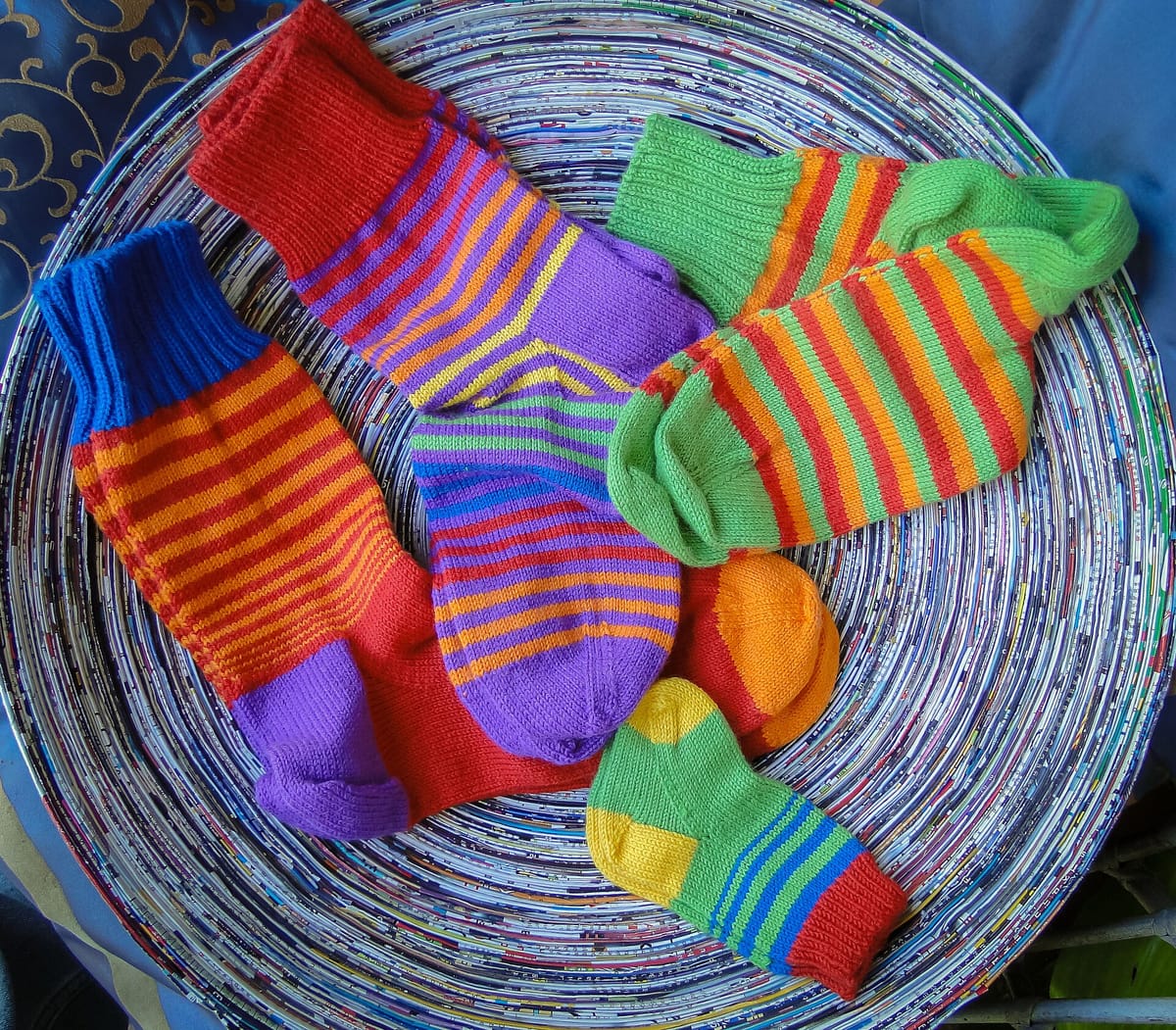
The parts of a sock
A cuff-down sock is a tube with a bend in it. You knit it in this order:
- Cuff: ribbing that holds the sock up.
- Leg: a plain tube down to the ankle.
- Heel flap: a flat panel worked back and forth on half the stitches.
- Heel turn: short rows that cup the bottom of the heel.
- Gusset: stitches picked up along the flap, then decreased away.
- Foot: a straight tube to just short of the toes.
- Toe: decreases on both sides, then a graft to close the tip.
The basic top-down sock pattern in Knitting and Crocheting All-in-One For Dummies follows these steps, and so does the sock calculator. Fiber and Sustenance notes that this heel flap and gusset is one of three common heels, alongside the afterthought heel and the short-row heel.
Yarn and needles for socks
Fingering weight, also sold as sock yarn or 4 ply, is the usual choice. The Craft Yarn Council puts it in weight 1, knitted at 27 to 32 stitches per 4 inches on 2.25 to 3.25 mm needles (US 1 to 3). The Dummies pattern uses US 1 (2.25 mm) and calls for 200 to 450 yards, depending on size.
Sock yarn often has nylon blended with the wool. Fiber and Sustenance mentions the blend and says nylon-free sock yarns exist too. Thicker yarn works as well: Sheep and Stitch writes its beginner pattern for worsted weight at 23 stitches per 4 inches, so the sock grows faster. The yarn weights guide explains the numbers on the label.
DPNs, magic loop or two circulars
A sock is too narrow for an ordinary circular needle, so you need one of these setups.
| Method | What you need | How it works |
|---|---|---|
| Double-pointed needles (DPNs) | A set of 4 or 5 short needles | The stitches sit on 3 or 4 needles and a spare one knits them off in turn |
| Magic loop | One circular with a long cable, around 32 inches (80 cm) | The cable pulls out in a loop between two halves of the stitches |
| Two circulars | Two circular needles in the same size | Each needle holds half the stitches and knits only its own half |
Fiber and Sustenance also lists very short circular needles made for small tubes like socks. Dummies writes its pattern so any of the three main setups works. On DPNs, Nimble Needles suggests pulling the yarn snug at each needle change and keeping decreases away from the gaps, which stops loose columns called ladders.
How many stitches to cast on
A sock should be a little smaller around than the foot, so it stretches to fit and stays up. That is negative ease. The sock calculator takes off 10 percent. Nimble Needles takes off about 15 percent, so sources differ here. The knitting ease guide explains the choice, and how to measure feet for socks shows where to wrap the tape.
At 32 stitches per 4 inches (8 per inch), an 8 inch foot works out to 57.6 stitches after ease. Rounded to a multiple of 4 for 2x2 rib, that is 56. The calculator does this rounding for you, along with every other count in this guide.
Cast on with a stretchy method so the cuff goes over the heel. The cast-on guide compares the options. Spread the stitches over your needles, then join into a round without twisting them.
How to knit socks, step by step
The numbers in each step are for the medium sock in the table further down. That is an 8 inch foot, 9.5 inches long, at 32 stitches and 44 rounds per 4 inches.
1. Knit the cuff
Work 2x2 rib (k2, p2) or 1x1 rib (k1, p1) around. Dummies knits 1x1 rib for 1 inch, Nimble Needles about 2 inches of 2x2 rib, and Sheep and Stitch 1 to 2 inches of 2x2 rib. Your cast-on must suit the rib: a multiple of 4 for 2x2, or of 2 for 1x1.
2. Knit the leg
Switch to stockinette, which in the round means knitting every stitch. Dummies works the leg for 5.5 to 8 inches, depending on size. The Craft Yarn Council lists a total sock height of 7 inches for a women's medium, measured with the cuff.
3. Work the heel flap
Put half the stitches on hold for the instep. Work the other 28 back and forth in rows. Dummies uses a slip-stitch pattern: on the right side, k1, sl 1 across; on the wrong side, sl 1, purl across. Nimble Needles uses a similar pattern because the slipped stitches thicken the fabric where heels wear out.
Slip the first stitch of every row. Those edge loops are where you pick up the gusset later. The calculator works as many rows as there are flap stitches, so 28 rows for this sock.
4. Turn the heel
Short rows narrow the bottom of the flap into a cup. For a 28 stitch flap, the turn begins like this:
- Row 1 (right side): sl 1, k15, ssk, k1, turn.
- Row 2 (wrong side): sl 1, p5, p2tog, p1, turn.
- Later rows: sl 1, work to 1 stitch before the gap left by the last turn, decrease across the gap (ssk on the right side, p2tog on the wrong side), work 1, turn.
Each row uses up more of the side stitches. When none are left, 16 stitches remain on the heel. Dummies describes the same method, ending with 16 to 20 stitches across its sizes.
5. Pick up the gusset and decrease
With the right side facing, pick up one stitch in each slipped edge loop down the side of the flap: 14 stitches. Knit across the instep, then pick up 14 more up the other side. You now have 72 stitches, 16 more than you cast on. The guide to picking up stitches shows how to close the gaps at the corners.
Decrease those extra stitches on the sole. Dummies works a k2tog on one side of the sole and an ssk on the other, every other round. That takes 8 decrease rounds, 16 rounds in all, to get back to 56.
6. Knit the foot
Knit even until the foot is long enough for the toe. Dummies stops 2 inches short of the full foot length. Nimble Needles stops when the sock reaches the middle of the little toe. With row gauge, the calculator works out the toe length exactly: 1.6 inches for this sock, so knit 7.9 inches from the back of the heel.
7. Shape the toe
A wedge toe decreases 4 stitches per decrease round, two at each side of the foot. Work a k2tog and an ssk at each side, with a decrease round every other round at first. For this sock that is 7 times, down to 28 stitches. Then decrease every round 4 times, leaving 12. Sources end the toe at different counts: 12 to 18 stitches for Dummies, 12 to 20 for Sheep and Stitch.
8. Graft the toe
Split the stitches onto two needles, 6 on the top and 6 on the sole. Close them with Kitchener stitch, which joins the two sets of live stitches with no seam. The Kitchener stitch guide walks through the repeat and the tail length. Weave in the ends, then knit the second sock to the same counts.
Sock plan for small, medium and large feet
These plans come straight from the sock calculator at 32 stitches and 44 rounds per 4 inches, 10 percent negative ease and 2x2 rib. Foot sizes are the Craft Yarn Council adult sock sizes, using the middle of each length range.
| Step | Small | Medium | Large |
|---|---|---|---|
| Shoe size (US) | Women's 4 to 6½ | Women's 7 to 9½, men's 6 to 8½ | Women's 10 to 12½, men's 9 to 11½ |
| Foot around × length | 7 × 8.5 in | 8 × 9.5 in | 9 × 10.5 in |
| Cast on | 52 sts (6.5 in around) | 56 sts (7.0 in around) | 64 sts (8.0 in around) |
| Heel flap | 26 sts, 26 rows | 28 sts, 28 rows | 32 sts, 32 rows |
| Heel turn | Row 1: sl 1, k14, ssk, k1; ends with 16 sts | Row 1: sl 1, k15, ssk, k1; ends with 16 sts | Row 1: sl 1, k17, ssk, k1; ends with 18 sts |
| Pick up each side | 13 sts (68 in total) | 14 sts (72 in total) | 16 sts (82 in total) |
| Gusset decreases | 8 decrease rounds (16 rounds) | 8 decrease rounds (16 rounds) | 9 decrease rounds (18 rounds) |
| Foot before the toe | 7.0 in from the back of the heel | 7.9 in from the back of the heel | 8.7 in from the back of the heel |
| Toe decreases | Every other round 6 times to 28 sts, then every round 4 times | Every other round 7 times to 28 sts, then every round 4 times | Every other round 8 times to 32 sts, then every round 4 times |
| Graft | 12 sts, 6 per needle | 12 sts, 6 per needle | 16 sts, 8 per needle |
The Craft Yarn Council gives a women's sock height of 6.5, 7 and 7.5 inches for these sizes, with the men's chart half an inch taller. Rounding moves the actual ease too: the small sock comes out 7 percent smaller than the foot and the medium 13 percent. For your own foot and gauge, enter them in the calculator.
Toe-up socks in brief
Toe-up socks start at the tip and finish at the cuff, so the parts come in reverse order. Fiber and Sustenance treats both directions as good choices. This guide covers cuff-down, the order the Dummies pattern and the sock calculator both use.
Sock knitting questions
How long does it take to knit a pair of socks?
Mary Maxim puts a sock at about 10 hours of knitting or less. Thicker yarn, such as the worsted in the Sheep and Stitch pattern, means fewer stitches and faster progress.
How much yarn do I need for socks?
The Dummies pattern lists 200 to 450 yards of fingering weight for a pair, across six sizes. Nimble Needles asks for 100 to 150 grams of sock yarn.
Which needles are best for a first pair?
Any of the three setups works, and the stitches and counts stay the same. Magic loop needs one long circular, two circulars need a matching pair, and DPNs come in sets of 4 or 5.
Why is there a hole beside my heel?
A gap can form where the gusset meets the instep. One fix is to pick up an extra stitch or two there and decrease them on the next round. The pick-up guide compares where two sources place them.
Sources and further reading
Knitting and Crocheting All-in-One For Dummies has the full basic top-down sock pattern in six sizes. Sheep and Stitch offers a worsted beginner sock pattern with video. Nimble Needles has a detailed step-by-step sock tutorial. Katherine Radburn compares yarn, needles and heels in Getting Started Knitting Socks. The Craft Yarn Council publishes the Standard Yarn Weight System.
Video tutorial
"TUTORIAL: How to KNIT SOCKS" by Voolenvine, on YouTube. The video loads only when you press play.