Needlepoint guide
How to cross stitch: a beginner's guide
Updated by Khokhar Sab
To cross stitch, separate 2 strands of floss, thread a blunt tapestry needle and start in the center of the fabric and the chart. Each square on the chart is one X: a diagonal stitch one way, then a second stitch crossing it. Keep every top stitch slanting the same way, and finish a thread by weaving it under stitches on the back.
What you need
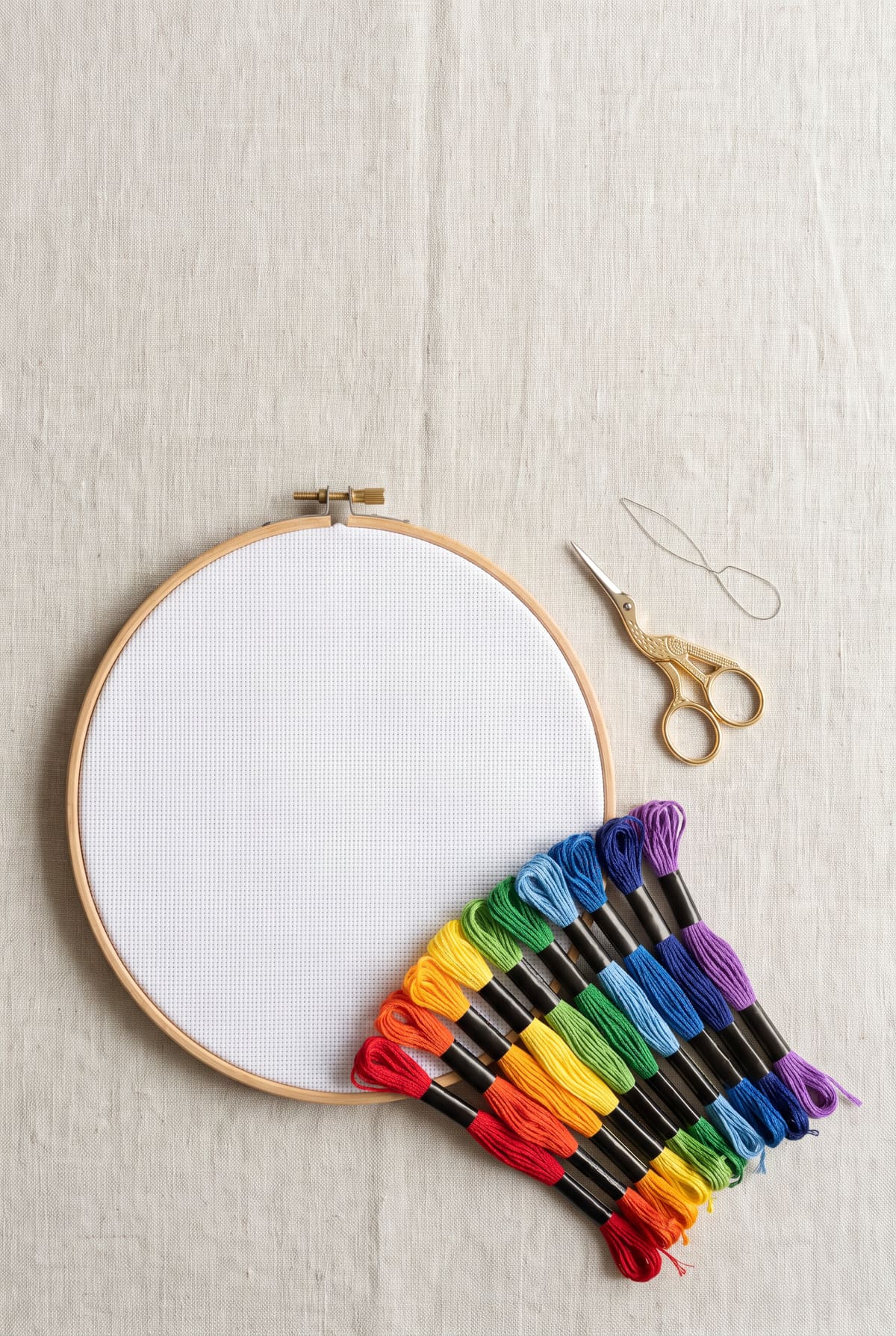
- Fabric. 14-count Aida is the usual first fabric. Its clear holes show exactly where each stitch goes. The guide to choosing cross-stitch fabric explains other counts and evenweave.
- Floss. Six-strand cotton embroidery floss, in the colors your chart lists. The strands pull apart, and you stitch with only some of them.
- A tapestry needle. Cross-stitch needles have a blunt tip and a large eye, so they slip between the fabric threads without splitting them.
- A chart. From a kit, a book or a download.
- Small sharp scissors, and a hoop if you like to hold the fabric taut.
Strands and needle size for each fabric
Needlework Tips and Techniques gives 2 strands of floss for 11 to 18-count Aida, and 2 strands over two threads for 25 to 36-count evenweave and linen. DMC's charts for 14-count Aida use 2 strands for cross stitch and 1 for backstitch outlines. Your pattern may say otherwise, and its instructions come first.
Needle sizes run the other way to what you might expect: a bigger number is a finer needle. World of Cross Stitching matches them to fabric like this:
| Fabric | Needle size | Strands for cross stitch |
|---|---|---|
| 11-count Aida | 22 | 2 |
| 14-count Aida | 24 | 2 |
| 16-count Aida | 26 | 2 |
| 18-count Aida | 28 | 2 |
| 28-count evenweave over two | 24 | 2 |
How to read a cross stitch pattern
A cross-stitch chart is a grid. Each square that holds a symbol or a color is one stitch, and an empty square means bare fabric.
- The key. It matches each symbol or color to a floss shade number. In a black and white chart the symbols do all the work.
- Bold grid lines. Every tenth line is darker, which splits the chart into 10 × 10 blocks that are easier to count.
- Center arrows. Arrows on the edges point to the middle row and column. Where they meet is the center of the design.
- Lines. A straight line along the edge of a square, or from corner to corner, is a backstitch.
- Other marks. Dots and small symbols show French knots, and a symbol filling only part of a square shows a part stitch. The key explains each one.
DMC and Crewel Ghoul both suggest starting at the center, where the arrows meet. It keeps the design centered on the fabric and cuts down on counting mistakes.
How to cross stitch, step by step
- Stop the edges fraying. Planet Rhinestone suggests masking tape folded over the edges, or a simple sewn border.
- Find the center of the fabric. Fold it in half one way and then the other. The point where the folds cross matches the center of the chart.
- Cut and split the floss. Cut a length of floss and pull out the strands you need one at a time, then lay them back together. Separating them first helps them lie flat.
- Start without a knot. A knot on the back makes a lump. With 2 strands, the loop start is the neatest way: take 1 strand twice as long, fold it in half and thread both cut ends through the needle. Come up from the back, leaving the folded loop hanging behind. Make your first half stitch, then pass the needle through that loop on the back and pull it snug. The loop start only works with an even number of strands. With an odd number, leave a tail on the back and catch it under your first few stitches.
- Make the first half of the X. Bring the needle up at the bottom left corner of a square and down at the top right.
- Cross it. Come up at the bottom right and go down at the top left. That completes one cross stitch.
- Work a row. There are two ways. The English method finishes each X before moving on. The Danish method works a whole row of half stitches, then comes back along the row to cross them. Either way, keep every top stitch slanting the same direction so the piece looks even.
- End the thread. On the back, weave the needle under several stitches you have already made, then trim the tail close.
How long to cut the floss
Cut Out + Keep's tutorial measures a length from an outstretched hand to the shoulder, and Crewel Ghoul works with 18 inch lengths. Every stitch uses the same short path whatever the length, so you can work out roughly how far one needleful goes. With 2 strands, each strand runs the whole path:
| Fabric | Thread path only | Allowing for tails and travel |
|---|---|---|
| 11-count Aida | About 41 stitches | About 26 stitches |
| 14-count Aida | About 52 stitches | About 34 stitches |
| 18-count Aida | About 67 stitches | About 43 stitches |
The second column uses the floss calculator's 55% allowance for the thread lost at starts, ends and moves on the back. If a needleful runs out much sooner than that, check that you aren't leaving long tails or carrying thread far across the back.
Part stitches: half, quarter and three-quarter
Some charts add part stitches for detail and contour. Planet Rhinestone's beginner guide describes them like this:
- Half stitch. Only the first diagonal of the X. Charts use it for backgrounds or to add a sense of depth.
- Three-quarter stitch. A half stitch with a quarter stitch on top, used for detail and curved edges.
- Two three-quarter stitches in one square. One in each color, for a smoother change between them.
On Aida there is no hole in the middle of a square, so you push the needle through the fabric for quarter and three-quarter stitches. The fabric guide explains why evenweave makes part stitches easier.
Counted or stamped cross stitch
Everything above is counted cross stitch: you follow a separate chart and count squares on plain fabric. Needlepoint.com describes the other kind, stamped cross stitch, where a kit has the design printed on the fabric and the print washes away when you finish. Stamped kits skip the counting. A counted chart can go on whichever fabric and count you choose.
How far one skein of floss goes
A skein holds 6 strands, and stitching with 2 means one skein makes three needlefuls of the full length. The floss calculator estimates that one 8 m skein covers about 1,770 full stitches on 14-count Aida with 2 strands, allowing for the thread lost at starts and ends. On 11-count, the bigger stitches bring that down to about 1,390. On 18-count it goes up to about 2,270.
For the finished size of your piece and how much fabric to buy, use the cross stitch fabric calculator. If you are still deciding between crafts, the cross stitch vs needlepoint guide compares the two.
Fixing common problems
Planet Rhinestone lists three problems beginners run into, with fixes:
- A miscounted stitch. Fix it as soon as you spot it. Remove the wrong stitches with a seam ripper or the needle, count again and restitch.
- Tangled thread. Don't pull the thread too hard or too fast, and use shorter lengths. If a knot forms, ease it along the thread toward the needle until it comes free.
- Uneven stitches. Pull every stitch with the same tension. A hoop keeps the fabric taut, which helps.
Tips for your first project
- Pick a small design with few colors and only full cross stitches.
- Stitch in good light. A white or cream fabric makes the holes easier to see.
- Keep the thread untwisted. Let the needle hang and spin now and then so the strands lie flat.
- Mark finished areas on a copy of the chart, so you always know where you are.
Sources and further reading
Crewel Ghoul explains charts in detail in How to Read a Cross Stitch Pattern. Needlework Tips and Techniques lists strands for each fabric in its fabric and thread conversion page. World of Cross Stitching has a needle size guide. Fat Quarter Shop covers the English and Danish methods and ending threads in Learn to Cross Stitch: Start Stitching. Planet Rhinestone's beginner's guide covers part stitches and fabric edges, and Cut Out + Keep has a step-by-step photo tutorial.
Video tutorial
"LEARN TO CROSS STITCH in 5 Minutes | How to Cross Stitch Tutorial for Beginners Flosstube" by Notorious Needle, on YouTube. The video loads only when you press play.